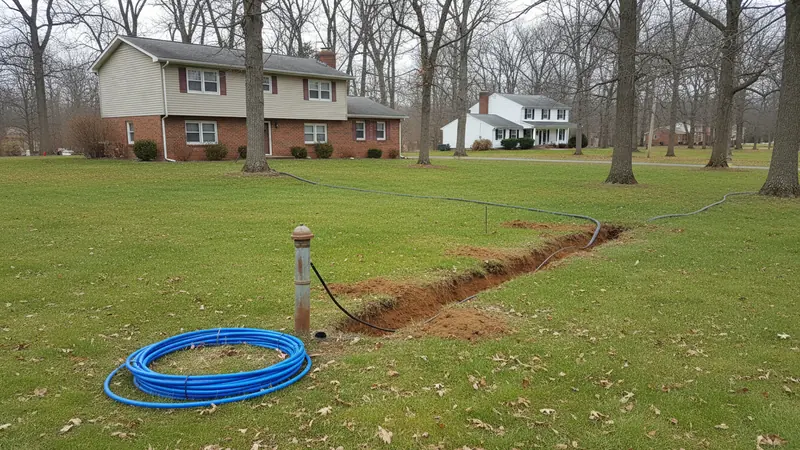
Before you book a well inspection, settle what you want checked. Records? Water yield? Water quality? The county's checks on newly installed equipment?
Start with the well's record
Howard County's public well and septic records search covers 1985 to present. You can use it to look for your well's permit and construction record. For an older home, bear that date range in mind. You may not find a record for every well.
Your well's history tells you more than the house's age alone. We found no county dataset linking well depth or yield to the decade a house was built.
(County records search read 21 September 2026.)
Yield and water quality answer different questions
A yield test measures water supply. Laboratory tests check the sampled water. Ask which tests your inspection includes.
Maryland's domestic well rule sets a minimum yield of 1 gallon per minute for 6 hours. You can end a test after 3 hours of continuous pumping at 4 gallons per minute or more. Replacement wells serving an existing home are exempt from the minimum yield requirement. That minimum does not tell you whether every existing well passes or fails.
(COMAR 26.04.04.26 read 21 September 2026.)
Local geology gives you a reason to test your own well. Maryland Geological Survey's Howard County study found yields ranging from dry holes to 100 gallons per minute in the Piedmont. Those historical results do not predict what your property can supply today.
(Bulletin 38, published 1995; research gathered 21 September 2026.)
What the county checks during installation
Howard County's pump installation form tells your installer to request an inspection before 9 a.m. on the day they want it. Leave the work uncovered until the Health Department approves it. The county checks for:
- A watertight pitless adapter and supply line. Both at least 36 inches below ground.
- A secure two-piece well cap. A properly attached well tag.
- Electrical conduit attached to the cap. It must sit at least 18 inches below ground.
- Casing 8 inches above the finished ground level.
- A supply line with a sleeve at the house. Enough grout below the adapter.
- A safety rope that does not run outside the cap or casing.
(County installation form revised 24 October 2018, read 21 September 2026.)
These checks are for an installation inspection. They do not define what you get in a homebuyer's inspection. We could not settle whether this inspection applies to a like-for-like pump replacement.
What remains unpriced
We found no separate county fee for a pump installation inspection. We could not verify a local price for a buyer's well assessment. Before you compare prices, ask what each inspection includes. A yield test? Laboratory tests? A check of the records? Water testing has separate published lab fees. Those are not the price of inspecting the whole well.
We recorded each figure's source and the date we read it.